
Orange dots beneath a chair, brown outlines beneath leaves and a white haze across pavers do not necessarily need the same treatment. Start by recording the pattern, the surface and what happened before the mark appeared. That information is more useful than asking for the strongest cleaner. A targeted assessment can distinguish removable contamination from a changed coating or surface, and help you decide when to test, when to monitor and when to ask a specialist.
Build a stain map before touching the surface
Take one wide photograph showing the marked area in relation to the house, garden and furniture. Then take a close photograph once the surface is dry. Add a familiar object nearby for scale without placing it on fragile material. Record when you first noticed the mark, whether it changes after rain and whether you have tried any cleaner already. This gives a contractor a short history rather than a colour description alone.
Look above and beside the mark. A metal fitting, a timber planter, mulch, irrigation or a leaking container may provide a clue. Move only lightweight objects that can be handled safely, and photograph the footprint before wiping it. Do not disturb loose building material or dismantle anything to trace the stain. If there is an active leak or damaged fitting, repair advice may be needed as well as surface cleaning.
Identify the material underneath. Concrete pavers, clay pavers, natural stone and a sealed slab can look similar in a cropped photograph. Find product details if possible. The same stain remover may not suit all of them, so a useful enquiry names both the suspected mark and the surface rather than asking simply for rust removal.
Orange or rust-coloured marks: inspect the source
An orange outline matching a metal furniture foot suggests a different investigation from scattered dots or a broad streak running down from a fitting. Describe that relationship without treating it as a confirmed diagnosis. Rust-coloured marks can come from several sources, and colour alone is not enough to choose a chemical. Keep the object or product details available so the cleaner can ask the right questions.
If a metal object continues to leave marks, cleaning the paving alone may offer only a temporary improvement. Ask how the source can be addressed, such as repairing the item or using a suitable protective arrangement recommended for that furniture and surface. Avoid improvised pads that trap water or stain the paving themselves. The goal is to prevent a repeat without introducing a new mark in the same location.
A targeted test should compare the stained area and nearby unaffected finish. Ask whether the proposed treatment could change the sealer or surface colour, and what happens if the test is inconclusive. Do not apply an acid-based product just because the bottle mentions rust. Compatibility, protection of adjacent materials and controlled rinsing are part of the assessment.
Brown leaf and timber marks: use the shape as evidence
Brown leaf outlines beneath damp litter can be different from a broad patch under an oiled planter. Record whether the mark appeared after leaves accumulated, after timber work or after applying a product to nearby furniture. This history matters because treatment for one source may not suit another. A contractor should not need you to name the chemistry correctly, but they do need an honest account of what was there.
Clear loose leaves with a suitable broom before they remain wet on the surface, provided the area is safe to access. Do not follow sweeping with a succession of household products. If a gentle product-approved clean fails, stop and preserve the result for assessment. Repeated experiments can obscure the original stain and make it harder to work out whether a new pale patch is residue, etching or a changed coating.
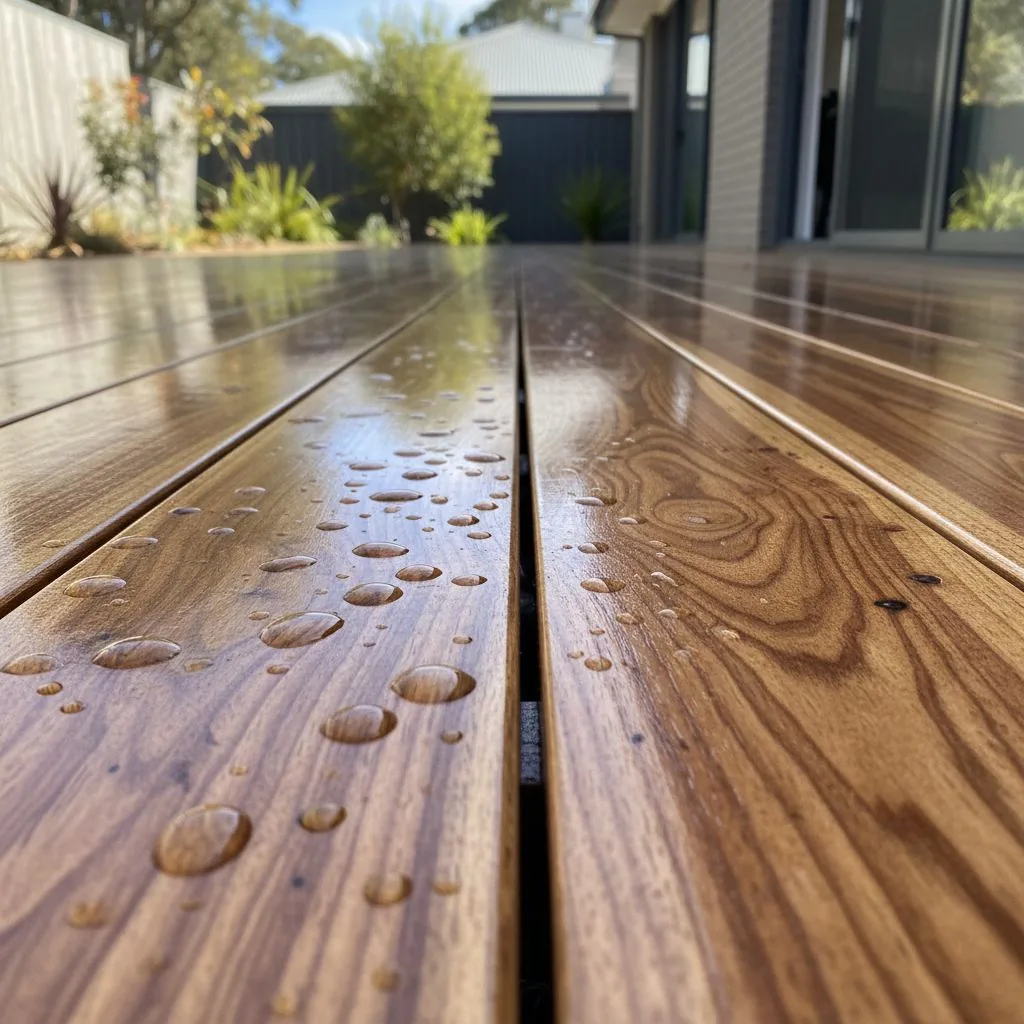
Where a timber deck meets paving, photograph both sides of the boundary. Note any recent oiling or cleaning of the boards and whether rinse water crossed the paving. The adjoining timber finish also needs protection during stain treatment. A plan that improves the pavers but leaves the deck visibly stripped has not solved the whole outdoor area problem.
White deposits: distinguish powder from a cloudy finish
National Masonry describes efflorescence as salts deposited when moisture moves through masonry and evaporates. Its guidance also notes that surrounding materials can contribute salts. That explains why a white mark can be related to moisture movement rather than dirt sitting on top. It does not prove that every white patch on your patio is efflorescence, especially if the surface has been sealed or recently treated.
Record whether the mark looks powdery, crusted or like a cloudy film, and whether it returns in the same place after the surface dries. Do not scrape aggressively to identify it. A pale coating defect and a mineral deposit may need different responses. Tell the assessor about recent sealing, building work and persistent damp areas so the diagnosis considers more than the visible colour.
Ask whether monitoring is reasonable before chemical treatment, and whether an ongoing moisture source needs attention. If a specialist cleaner is proposed, check the paving manufacturer's advice and test an inconspicuous area. Removing a visible deposit does not necessarily remove the conditions that brought it to the surface, so an immediate promise of permanent disappearance deserves careful questioning.
| What you notice | Useful next step | Avoid |
|---|---|---|
| Orange footprint under metal furniture | Photograph source and request a compatible targeted test | Choosing acid from colour alone |
| Brown leaf-shaped marks | Record leaf buildup and material identity | Mixing household cleaners |
| White powder or haze | Check moisture history and any sealer | Assuming every white patch is efflorescence |
A controlled treatment sequence
First identify the likely source and the underlying material. Next check the manufacturer's cleaning advice and decide whether the mark needs specialist assessment. Then agree a discreet test, including how nearby plants, doors and timber will be protected. Review that result dry before treating a larger area. This sequence creates stopping points when the evidence is uncertain, rather than committing the entire patio to one guess.
Do not mix cleaners, including products left from an earlier attempt. Give the contractor their names and approximate timing. Follow the relevant product label and safety information rather than a homemade recipe. Stronger concentration is not a substitute for knowing whether the chemical is suitable. It can also make controlled application and rinsing more difficult around a garden or doorway.
If the test improves the mark only partly, discuss whether further treatment is worth the risk of an uneven finish. A small residual stain may be preferable to a large pale patch. Ask for that trade-off in plain language before deciding. The decision should account for where the mark sits, how visible it is and whether the source has actually been removed.
Consider where treatment water will travel
A Pakenham courtyard may have only a narrow route between the work area and the street. A larger garden may have several paths and drains. Neither layout tells you automatically where dirty water should go. Show the contractor the actual drains, garden beds, deck edges and door thresholds. Ask how residue will be contained or collected and how the adjacent surfaces will be checked after treatment.
Pay attention to downhill areas that are easy to overlook. A stain near a barbecue can be small while the rinse path crosses an entire patio. Mark ponds, edible planting, pet bowls and children's play areas on your sketch. Move portable items safely beforehand, and agree how fixed objects will be protected. Avoid relying on a general environmentally friendly claim when a specific treatment is being proposed.
Check the completed rinse path as well as the original mark. Look for residue in texture, splash marks on lower walls and dirty water collected against timber or thresholds. The scope should state whether the adjacent area will be rinsed and checked. That prevents a targeted stain treatment from creating a second cleaning job just beyond the quoted patch.
Hypothetical example: three marks around one outdoor table
Imagine a Pakenham patio with orange rings beneath two chair legs, brown leaf shapes near the garden and a white haze beside a planter. The owner photographs all three and initially requests one pressure wash. A better enquiry describes the three patterns separately and includes the paver invoice, the age of the sealer if known and the recent history of the planter area.
The cleaner proposes an ordinary surface clean only where appropriate, followed by separate assessment of the remaining marks. The owner removes the metal chairs from the wet area and clears leaf litter. The white patch is reviewed in relation to the damp planter edge rather than assumed to be the same problem as the orange rings. Each decision now has a relevant observation behind it.
After a dry review, the owner can decide whether targeted treatment is justified for the chair marks and whether the planter arrangement needs changing. They keep photographs showing the remaining haze so a later comparison is meaningful. The result is a practical sequence with different endpoints, rather than an unrealistic requirement that every mark vanish in the first pass.
Keep a useful record if the mark returns
Photograph the treated patch after it dries, then use the same angle when comparing it later. Record relevant events such as prolonged leaf accumulation, moving a planter, irrigation changes or resealing. A returning mark in the same outline can help identify an unresolved source. A new mark somewhere else may be a different issue, so avoid assuming that every later stain proves the original treatment failed.
Keep the product name and care instructions with the photographs. If you contact another contractor, share what was used before they propose a new treatment. This is particularly important where the surface is sealed or where a targeted process was stronger than the general wash. Accurate history is useful even if you do not remember the exact concentration; do not guess details that could affect compatibility.
Use the brief builder to describe the pattern, prior treatments and nearby surfaces. Request an assessment rather than a guaranteed stain removal outcome from photographs alone. Once the surface and source are understood, the contractor can explain the likely improvement, the limits and the appropriate test. That leaves you with a decision based on your patio rather than a generic promise about every outdoor stain.